
VISaR
Vulnerability Identification, Scanning & Reporting
A free, open-source command-line tool that scans GitHub repositories against known vulnerability databases — built for data platform teams who need a repeatable evidence record before approving open-source dependencies.


The Problem
Most of your codebase is code you didn't write.
Every open-source library you pull in, along with every dependency it brings with it, is a potential entry point into your data platform. In regulated environments, “we think it's fine” isn't an answer an auditor accepts, and AI assistants now generate dependency choices faster than anyone can vet them by hand.
VISaR turns that vetting into a repeatable, ten-second command. Point it at a repository and get back a structured, severity-rated report you can keep as evidence. Every dependency approval is backed by the same check, run the same way, every time. It started with a a client asking exactly that question.
Interactive Dashboard
One file. Every scan. No server, no setup.
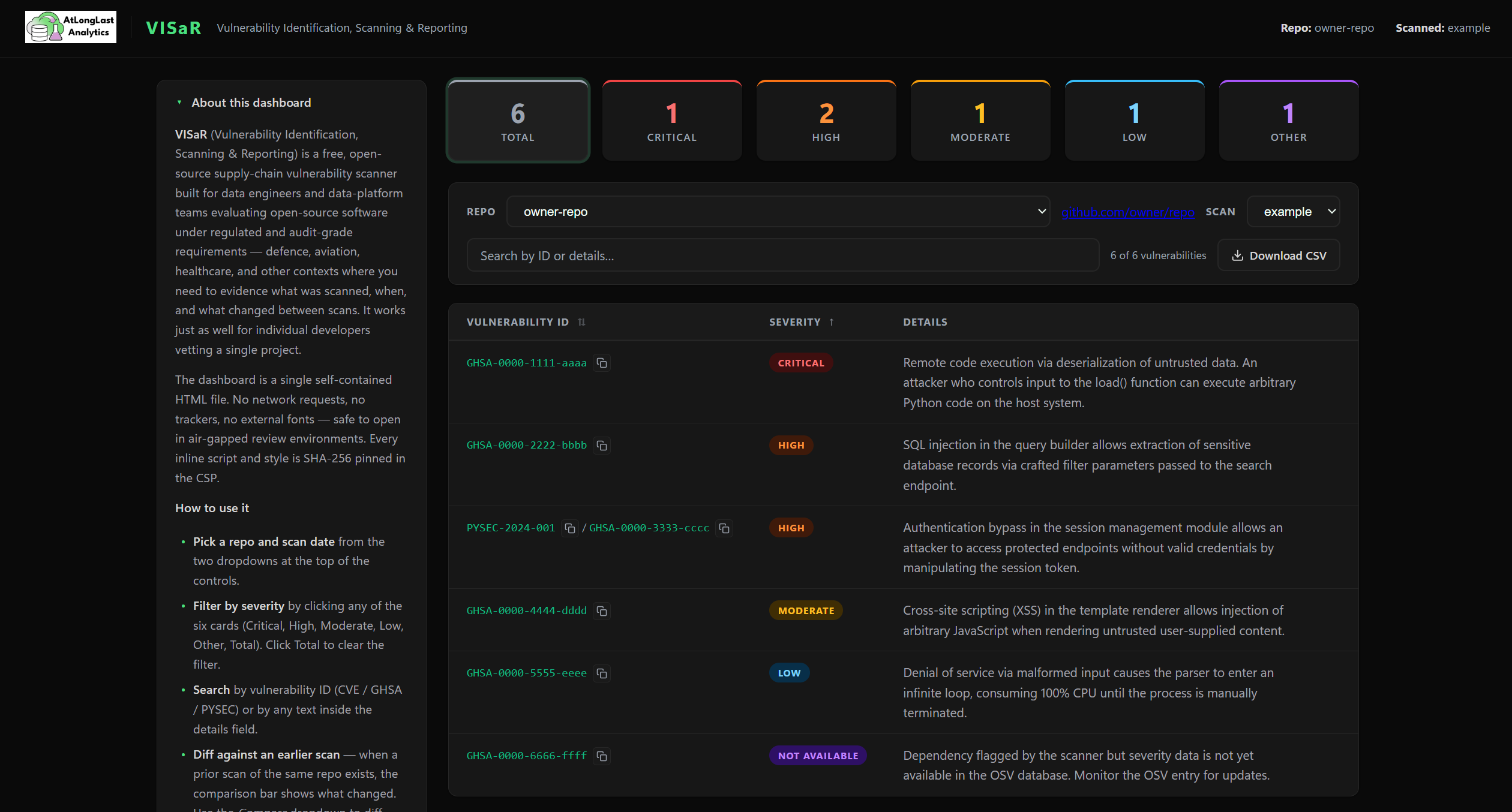
VISaR v1.1.0 rolls every scan in your data/ directory into a single self-contained HTML dashboard. Filter by severity, switch between scans, expand any row for the full vulnerability description — all in one file you can email, attach, or drop into a shared drive.
How It Works
From a repo URL to an evidence record — in four steps.
Under the hood, VISaR leans on best-in-class open source: the OSSF Scorecard for identification and the OSV database for enrichment. Output is available as CSV, JSON, or the interactive HTML dashboard above.
Who It's For
Built for teams that have to prove what they scanned.
Quick Start
Up and scanning in under 5 minutes.
Clone, sync dependencies with uv, complete a one-time setup, and point VISaR at any public GitHub repository.
- Python 3.12+ (managed automatically by uv)
- Docker Desktop (2 GB available memory)
- GitHub personal access token with
public_reposcope - Network access to
api.github.comandapi.osv.dev
Current limitations
- Public GitHub repositories only (private repos are not supported yet).
- Batch scans run sequentially (one repository at a time).
- Docker Desktop must be running before a scan.
# 1. Clone and sync
git clone https://github.com/AtLongLastAnalytics/visar
cd visar
uv sync

# 2. One-time setup
cp .env.example .env
# set VISAR_AUTH_TOKEN in .env
docker pull gcr.io/openssf/scorecard:stable

# 3. Scan a single repository (writes CSV to data/)
uv run visar https://github.com/matplotlib/matplotlib

# 4. Batch scan from a list
uv run visar --batch repos.txt

# 5. Build the interactive dashboard
uv run visar-dashboard          # writes data/visar_dashboard.html

# Want to look first? Preview with the bundled example data:
uv run visar-dashboard examples
Release Notes & Background
From the blog
VISaR v1.1.0: Batch Scanning and Interactive Dashboard
VISaR v1.1.0 adds batch scanning across multiple repos and a self-contained HTML dashboard for sharing results. No server, no setup, just a file your team can open and explore.
VISaR: A Code Scanning Tool for Data Platform Engineers
VISaR is a free, open-source tool for scanning GitHub repositories against known vulnerability databases. Built after a client asked how to quantify their open-source risk.
Common Questions
The questions teams ask before customising.
Can we use VISaR commercially?
What does a customisation engagement look like?
Do we own the custom features, or are they upstreamed?
Do you offer support contracts for the stock OSS version?
Consulting
Need a private deployment or custom features?
Off-the-shelf scanning doesn't always fit highly regulated environments. We deploy VISaR inside your security boundary and extend it for your stack, compliance regime, and reporting workflows.